
The AI Whistleblower Protection Act (S.1792/H.R.3460) already meets most of what strong AI whistleblower legislation requires, but a handful of gaps could still leave some of the best-positioned safety witnesses unprotected.
The Center for AI Risk Management and Alignment (CARMA) and the AI Whistleblower Initiative (AIWI) set out five categories of suggested amendments — covering material scope, personal scope, penalties, remedies, and reporting channels — grounded in precedent from the Whistleblower Protection Act, Sarbanes-Oxley, and state whistleblower law.
This analysis benchmarks the Bill against existing best practice, examining how whistleblowing statutes in other jurisdictions have addressed the distinctive risks and structure of the AI industry.
It is based on the text of the bill and on publicly available resources and information and represents our independent assessment.

Overview
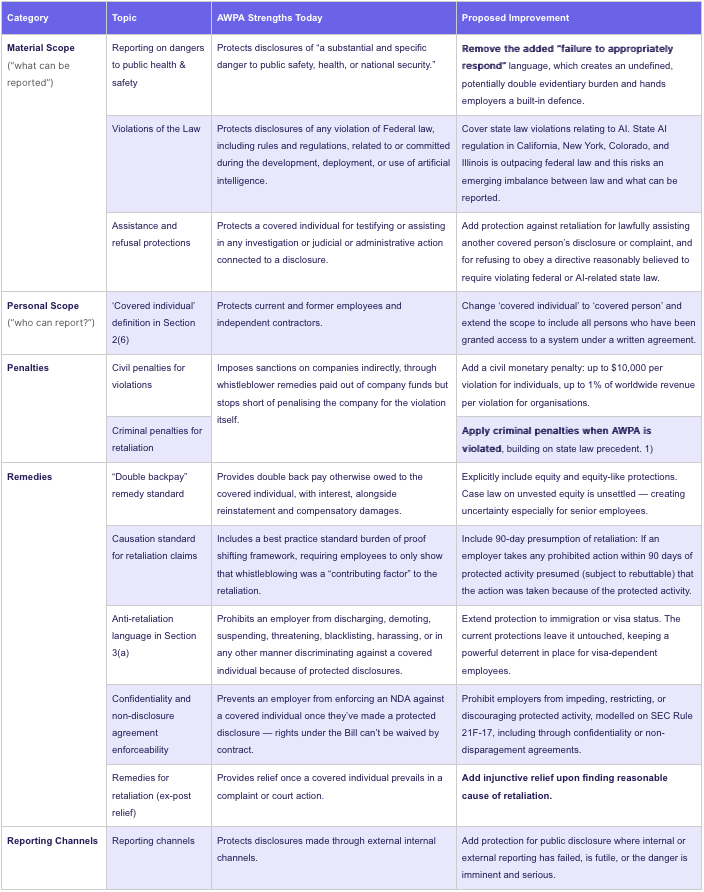
1 ) OK Stat. tit. 40, § 199 and CA Labor Code sec. 1103
Introduction
The AI Whistleblower Protection Act (introduced in the Senate as S.1792 by Senator Chuck Grassley with bipartisan co-sponsorship and in the House as H.R.3460) is the first piece of US federal legislation written specifically to protect the people inside AI companies who raise safety concerns.
For the first time, frontier AI insiders would have a federal, purpose-built protection rather than a patchwork of statutes across states and designed for other industries.
We support the bill, and we want to see it enacted — ideally in a strengthened form that closes gaps to existing best practice.
The AI Whistleblower Protection Act (AWPA) already performs well when measured against best practice. The table below sets out a complete comparison against best practice.
What AWPA Does Well
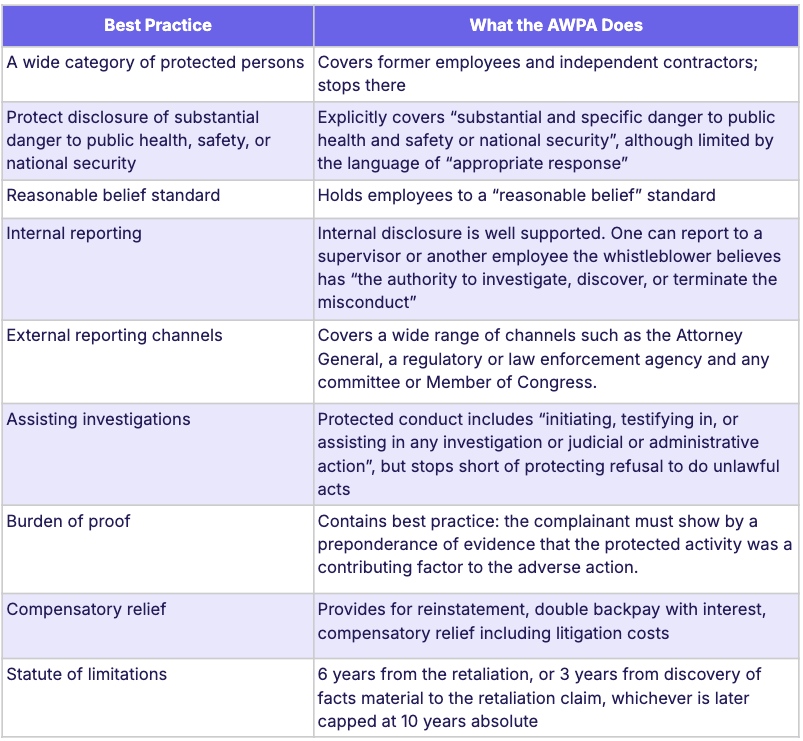
There are still some ways in which AWPA falls short of best practice, potentially leaving some of the best-positioned safety witnesses without whistleblower protections.
In the section below, we present a set of recommended amendments — across five categories — which would help it achieve what it sets out to do: ensuring the visibility of all risks stemming from the development and deployment of AI.
1. Material Scope
Remove the “failure to appropriately respond” language in Section 2(2)(B)
The concern
The language of “failure to appropriately respond” is unprecedented in (federal) whistleblowing law. We believe it will take years of case law to resolve, and it will probably weaken early claims at the moment they most need to succeed.
Suggested remedy
We recommend simplifying Section 2(2)(B) by removing the “failure to appropriately respond” wording. This emulates the Whistleblower Protection Act formulation and protects disclosures of “a substantial and specific danger to public safety, public health, or national security” arising from the development, deployment, or use of artificial intelligence, regardless of whether a company “failed to appropriately respond” to such a danger.
Include state law violations within the protected class of disclosures
The concern
The definition of “AI violation” in Section 2(2)(A) is limited to federal law. This is a drafting choice that is likely to produce sharp anomalies in the coming years. State AI regulation is developing rapidly. California (SB 53, SB 942, AB 2013), New York (the RAISE Act and associated measures), Colorado (SB 205), and Illinois all have statutes on AI disclosure, safety, or discrimination either enacted or under active consideration.
Federal law has not matched the pace of state legislation, and the gap may widen before it closes. If AWPA protects only disclosures of federal law violations, then a researcher who reports that their employer is violating California’s safety framework requirements, or New York’s impact assessment rules, is unprotected by federal whistleblower statute.
Suggested remedy
We recommend amending Section 2(2)(A) to cover violations of any federal law or any state law to the extent that the state law relates to the development, deployment, or use of artificial intelligence. Reports to state regulators or state Attorneys General should be correspondingly added to the list of covered channels in Section 3(a)(1).
Protect refusal to follow presumed unlawful orders and assistance to covered persons making disclosures
The concern
The bill currently does not explicitly protect individuals assisting any other covered person in making a disclosure. Likewise, it does not protect individuals refusing to obey any directive that a covered person may believe would be a violation of the Act. Both are covered protections for federal employees under 5 U.S. Code § 2302.
Suggested remedies
Following precedent from U.S. Code, protect individuals from retaliation for:
lawfully assisting any other covered person in making a disclosure described in paragraph (1) or in initiating, filing, or pursuing any complaint or action under this section; or
refusing to obey any directive that such a covered person reasonably believes would require the covered individual to violate any Federal law, rule, or regulation, or any State law, rule, or regulation related to the development, deployment, or operation, or use of artificial intelligence.
For more details, read the full Material Scope section here, including our reasoning for each of the recommended amendments.
2. Personal Scope
Extend coverage to employees and contractors of AI evaluation and auditing organisations
The concern
Under the current definition, some of the people best positioned to detect safety failures at frontier AI developers fall outside the protected class.
We mean here researchers employed by independent evaluation organisations. Researchers at these organisations are often commissioned, through a partnership (not a paid contract) that their employer has with a frontier AI lab, to run pre-deployment evaluations on a frontier model developed by a large lab.
During testing, these researchers are well positioned to observe material violations that fall within the material scope of applicable whistleblowing legislation: evidence that the lab has selectively reported evaluation results, that an evaluation was structured in a way that predictably understated capability, evidence of misrepresenting results to regulators, or deployment of a system whose evaluations flagged substantial risks.
These researchers have a contractual relationship with their organisation, not with the frontier lab. The lab is the target of the concern, but the researcher has no employer/employee or employer/contractor relationship with the lab. On a plain reading of Section 2(6), any of these researchers is not a “covered individual” vis-à-vis the lab whose conduct they want to disclose. They are an employee of their organisation, which is itself a contractor of the lab. This section thus leaves outside its reach some of the most important safety-relevant personnel.
Suggested remedies
We recommend expanding the definition of “covered individual” to include, in addition to employees and independent contractors of the employer itself, one or more of the following phrasings:
Following language precedented in the False Claims Act, move from “individual” to “person”, following the USC definition – including organizations.
Expand the definition of “Covered Person” to include a person who has been granted access to a non-public AI system or related safety-relevant information by an employer under a written agreement.
Permit a covered person described above to bring a civil action in the appropriate federal district court in lieu of filing a complaint with the Labor Secretary, if that pathway is not appropriate for a covered person.
A parallel change is needed in Section 3, so that “employer” in the retaliation prohibition includes any entity that can influence (whether paid or not), based on a written contract, a covered person’s work for the developer in question, not only the covered individual’s nominal employer of record.
For more details, read the full Personal Scope section here, including our reasoning for each of the recommended amendments.
3. Penalties
Include Civil Penalties for Violation of the Act
The concern
The AWPA currently includes no civil penalties for violations. This matters for two reasons. Firstly, establishing a deterrent to whistleblowing is generally valuable. Secondly, not all violations covered under the AWPA are violations of other laws, where a violation could introduce a penalty dimension.
Civil penalties from state laws are also wholly insufficient deterrents given the financial resources available to companies covered under the Act.
Suggested remedy
Companies should be fined for retaliatory behaviour against whistleblowers. For these fines to be meaningful in the AI industry where revenue is often greater than $5bn annually, fines should be formulated as a proportion of revenue. We suggest adding the following:.
(1) CIVIL PENALTY.—In addition to any relief under subsection (b), the Secretary of Labor may, after notice and an opportunity for a hearing on the record, assess a civil monetary penalty against any person that violates subsection (a). The penalty shall not exceed—
(A) in the case of an individual, $10,000 for each violation; and
(B) in the case of an organization, a penalty of not more than 1 percent of the total worldwide annual revenue of the organization for the preceding fiscal year per violation.
Include Criminal Penalties for Retaliation
The concern
Currently, the bill includes no sanctions for retaliation against whistleblowers. Sanctions are only included indirectly via whistleblower remedies, which are paid by companies. Where responsibility is assigned to companies, especially those with access to large funds, responsibility as well as deterrence is diluted.
To combat these issues, section 1107 of the Sarbanes-Oxley Act added 18 U.S.C. § 1513(e), making it a federal crime to retaliate against anyone who provides a law enforcement officer with truthful information about any federal offense. Penalties include up to 10 years’ imprisonment for individuals. §1513 does not apply however in the majority of whistleblowing cases, but only to the narrow case of reporting violations of the law to law enforcement. Reporting a violation of the law to Congress or an Attorney General, for example, would not be covered.
Suggested Remedy
We suggest that criminal penalties apply when AWPA is violated, building on state law precedent OK Stat. tit. 40, § 199 and CA Labor Code sec. 1103.
(2) CRIMINAL PENALTY.—
(A) OFFENSE.—An individual who knowingly and willfully, and with intent to retaliate, violates subsection (a) is guilty of a misdemeanor, punishable by imprisonment for not more than one year.
(B) AGGRAVATED OFFENSE.—If a violation of subparagraph (A) involves a threat or use of force or violence, or is committed against a person who disclosed information concerning a substantial and specific danger to public health, safety or national security, the offense is punishable by imprisonment for not more than 5 years.
(C) INDIVIDUAL LIABILITY.—Subparagraphs (A) and (B) apply to any individual officer, director, manager, employee, or agent who authorizes or knowingly participates in the prohibited conduct.
(D) RULE OF CONSTRUCTION.—The penalties under this subsection are in addition to, and do not preempt or diminish, any civil remedy or administrative penalty available under this Act or any other law.
For more details, read the full Penalties section here, including our reasoning for each of the recommended amendments.
4. Remedies and Retaliation Protection
Explicitly Include Equity Protections
The concern
Compensation at frontier AI firms such as OpenAI and Anthropic is heavily weighted toward equity or equity-like instruments. At Anthropic, self-reported compensation data indicates a median total pay for engineers of approximately $557k per annum, with 44 to 57% coming from equity. OpenAI has a mixed compensation structure, in part using a traditional equity mechanism, restricted stock units (RSUs), and in part offering employees profit participation units (PPUs) rather than traditional equity.
As equity vests on a schedule and can only be sold at given times, frontier labs’ equity structures could result in an employee having multiples of their salary locked in equity. Employees experiencing retaliation might stand to lose the vast majority of their savings – a situation we have seen play out in practice before.
Existing whistleblower statutes do not explicitly account for this. As compared to SOX’ broad ‘make whole’ standard, Dodd-Frank, and the proposed AI Whistleblower Protection Act provide double “backpay”, reinstatement, and damages, but do not explicitly address equity instruments.
The case law on whether unvested equity, for the purpose of ‘double backpay’, is compensable under these provisions is thin and contested. Courts have recognised that equity-based compensation, including stock options, may be recoverable as damages in employment disputes.
On its face today, the AWPA hence likely allows a) reclaiming of lost vested equity and b) an inclusion of unvested equity in ‘double backpay’ or other damages. However, courts have also characterised such damages as inherently speculative and fact-dependent, and commentators frequently note a relative lack of settled, authoritative doctrine governing the treatment of equity-based compensation in employment retaliation and wrongful termination cases. Most recently, in Shah v. Skillz Inc., the court held that stock options are not “wages”.
This lack of explicit clarity may deter especially the most senior AI company employees, who are both most able to spot violations and most exposed to the deterrent this risk presents.
Suggested Remedy
The remedies available should be explicit in including “(B) Two times the amount of back pay, including benefits such as, but not limited to, equity or equity-like compensation, otherwise owed to such covered person, with interest.
Include 90-day presumption of retaliation
The concern
Establishing causation in retaliation claims can be challenging – even in cases where a protected activity is temporarily close to a retaliatory action. California has addressed this issue in SB 497, which posits that any adverse employment action (such as firing, demoting, or disciplining) taken within 90 days of a protected activity should be deemed unlawful retaliation by default. This also more closely mirrors existing best practice globally, which does not require employees to provide evidence of reporting being a contributing factor for a burden of proof shift at all.
Suggested remedy
Replicating the language of SB 497, we suggest adding the following: If an employer takes any action prohibited under subsection (a) within 90 days of a covered person’s protected activity under subsection (a), there shall be a rebuttable presumption that such action was taken because of the protected activity.
Introduce protection specifically for non-US citizens on visas
The concern
Many workers at frontier AI companies who might report safety violations are on non-immigrant visas. H-1B most commonly, but also O-1, L-1, and others. Their legal status in the United States depends on continued employer sponsorship. This creates a chilling effect: an employee who knows that disclosure could cost them their job knows simultaneously that it could cost them their right to remain in the country, upend their family, and potentially void years of progress toward permanent residency. S.1792’s existing anti-retaliation language addresses employment consequences but does not touch immigration status, leaving a powerful deterrent intact.
At the same time, the individuals working for these companies are valuable talent for the U.S. Labor Market and should be retained.
Suggested remedy
Add language like the following, mirroring the proposed POWER Act.
“Notwithstanding any other provision of law, withdrawal or non-renewal of an employer’s petition for a covered individual’s nonimmigrant classification shall constitute retaliation under Section 3(a) if taken in response to protected activity under that section. Upon a credible showing (as determined by the Secretary of Homeland Security based on documentary evidence of the disclosure and subsequent employer action) that nonimmigrant status has lapsed or is imminently at risk due to such retaliation, the Secretary of Homeland Security shall grant the covered individual employment authorization and a stay of removal for up to 2 years, renewable while any complaint under Section 3(b) remains pending.”
In addition, the injunctive relief (see below) adjustment should also cover visa-related retaliation, in combination with expanding the list of prohibited conduct by
“No employer may, directly or indirectly, discharge, demote, suspend, threaten, blacklist, harass, or in any other manner discriminate against a covered individual, including through any action affecting the covered individual’s immigration status, in the terms and conditions of employment…”
Prohibit acts that impede whistleblowing
The concern
The bill provides that a covered individual’s rights cannot be waived and, as a result, an employer cannot enforce a confidentiality or non-disclosure agreement against a whistleblower who makes a protected disclosure. However, this does not address the chilling effect such agreements can have before any disclosure is made.
A broad confidentiality, non-disparagement, or non-disclosure provision may deter an employee from reporting safety concerns even where the provision would ultimately be unenforceable. An employee who is unsure of their rights, concerned about litigation, or unwilling to risk a dispute with their employer may choose not to report at all.2
Suggested remedy
Add a provision modelled on SEC Rule 21F-17, making it unlawful to impede, interfere with, or discourage a protected disclosure, including through the use of contractual restrictions.
“No employer may directly or indirectly impede, interfere with, restrict, or discourage a covered individual from engaging in protected activity under this Act, including by imposing, maintaining, enforcing, or threatening to enforce any confidentiality, non-disclosure, non-disparagement, or similar agreement that could reasonably be understood to prohibit or restrict such activity.”
Introduce Injunctive Relief
The concern
Injunctive relief protects whistleblowers by allowing them (in cases where there is reasonable cause to believe that they have been retaliated against) to maintain their position while litigation is on-going rather than only receive ex-post relief.
Suggested remedy
We suggest adopting the text from CA Labour Code 98.7 which allows the Labor Commissioner to petition the superior court for temporary or preliminary injunctive relief, upon finding reasonable cause to believe that a person is engaging in a violation.
For more details, read the full Remedies and Retaliation section here, including our reasoning for each of the recommended amendments.
5. Reporting Channels
Include Conditions for public disclosure
The concern
The Bill is entirely silent on the circumstances, if any, under which a covered individual may go public with a concern, whether to the press, to the research community, or to the general public, and retain protection.
While it is unprecedented in the US to allow employees to directly make a disclosure to the public, other jurisdictions protect disclosures of risk to public health and safety in cases where the risk is imminent and material. Those developing AI state that it is an unprecedented and high-risk technology — the law should reflect this.
Public disclosure is an alternative to increasing the regulation on companies: instead of introducing burdensome risk management legislation, one can allow for a more nimble approach that allows companies to innovate, but then immediately respond and alert the public if risks arise.
Suggested remedy
We recommend including a provision that protects public disclosure where: (a) the covered individual has first reported through internal or external channels and no adequate action has been taken within a reasonable period; or (b) the covered individual reasonably believes that the matter involves an imminent and serious danger to public safety or health; or (c) the covered individual reasonably believes that reporting through internal or external channels would be futile or would result in retaliation or concealment of evidence. Disclosures involving classified information should not qualify for public disclosure protection.
For more details, read the full Reporting Channels section here, including our reasoning for each of the recommended amendments.
The full publication is downloadable here on our website and includes further reasoning on each suggested amendment.
About the Authors
Mark Gitau, Legal Research Fellow, CARMA
Raqda Sayidali, Research Scholar, ILINA Program and Legal Research Fellow, CARMA
Karl Koch, Founder & MD, The AI Whistleblower Initiative (AIWI)
Abra Ganz, Senior Researcher, CARMA and Head of AI Policy, Pour Demain
OK Stat. tit. 40, § 199 and CA Labor Code sec. 1103
U.S. Government Accountability Office, “Protections for Whistleblowers and Others: Selected Agency Actions Regarding Reports of Potential Wrongdoing,” GAO-26-107650, March 2026, pp. 1–2, 11, and 16, available at, https://www.gao.gov/assets/gao-26-107650.pdf.
The 90-day retaliation presumption is the sleeper provision here, and I'd argue for extending its logic: protection that activates only after a tribunal reconstructs the timeline is protection most workers can't afford to invoke. What makes the presumption work is that it shifts who must produce the record. Which points at a gap in all five amendment categories: the bill protects the discloser but says nothing about the disclosure's evidentiary trail — and in practice the employer holds the systems the evidence lives in (Slack, eval logs, model cards) and can lawfully rotate it away under retention policy the day a report lands. A preservation duty triggered by the report itself — everything touching the disclosed system, frozen, dated — would do more for the "best-positioned safety witnesses" than penalty escalation, because it converts the report from one person's word into a record the institution can no longer quietly re-author.